
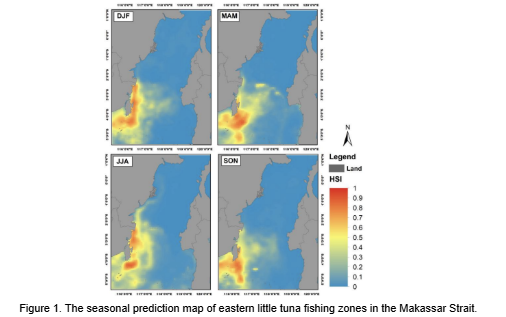


A new study published in AACL Bioflux (2025) provides important insights into the seasonal migration patterns of eastern little tuna (Euthynnus affinis) in the Makassar Strait. Using satellite-derived oceanographic data (sea surface temperature, sea surface height, chlorophyll-a) combined with catch records from 2019–2020, researchers applied the MaxEnt model to predict tuna habitat suitability with high accuracy (AUC = 0.877). The findings reveal that tuna catches were highest during transitional seasons (March–May and September–November), where optimal habitat conditions occurred.
The study highlights that eastern little tuna prefer waters with chlorophyll-a concentrations between 0–2 mg/m³, sea surface height around 0.55–0.56 m, and sea surface temperatures above 29°C. These parameters drive habitat suitability, with transitional and northwest seasons showing wider fishing zones across the eastern Makassar Strait. Identifying such seasonal shifts is crucial for sustainable tuna fisheries management, reducing uncertainty for local fishers, and ensuring long-term resource utilization.
This research contributes to the achievement of United Nations Sustainable Development Goals (SDG 2 – Zero Hunger, SDG 8 – Decent Work and Economic Growth, SDG 12 – Responsible Consumption and Production, and SDG 14 – Life Below Water).
Full article: https://www.scopus.com/pages/publications/105008768857
Meet the Researchers
This study was conducted by Mila N. Kamilah and Ajeng R. Puspita (Master of Marine Conservation Study Program, Universitas Padjadjaran) and Mega L. Syamsuddin (Department of Marine Sciences, Universitas Padjadjaran).
Hashtags
#TunaResearch #MakassarStrait #FisheriesManagement #MarineScience #UnpadResearch #SDG2 #SDG8 #SDG12 #SDG14