
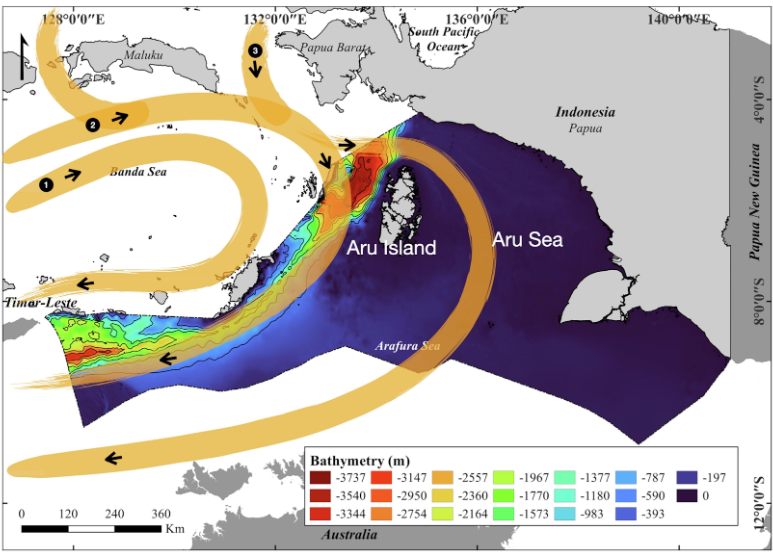


A research team examined how small-scale fishing unfolds in the Aru Sea (FMA 718) by combining in‑situ tracking of fishing trips with satellite‑derived oceanographic data—sea surface temperature, sea surface height, chlorophyll‑a, and currents. The goal was to better understand why fishing “hotspots” appear when and where they do, and how those patterns shift across monsoon seasons.
The study shows that productive grounds are not defined by a single variable. Instead, they emerge when favorable conditions overlap—moderate temperatures, nutrient‑rich waters (indicated by elevated chlorophyll‑a), and current features that can retain or concentrate prey. During the southeast monsoon, stronger winds and regional current dynamics redistribute plankton and small pelagics, which in turn attract larger fish and fleets. In contrast, the northwest monsoon modifies fronts and eddies, sometimes dispersing fish schools and reducing catch predictability. These dynamics help explain why catch rates can fluctuate even when surface temperature alone appears optimal.
Importantly, the authors argue for moving beyond single‑factor rules of thumb (e.g., “fish when the water is X °C”). By integrating multi‑source data with vessel tracks, managers can identify persistent, safe, and sustainable fishing areas, anticipate shifts during climate anomalies, and reduce fuel costs from unproductive searching. For enforcement, overlaying hotspot maps with vessel movements supports smarter monitoring of illegal, unreported, and unregulated (IUU) activity. The approach also strengthens climate resilience: as ENSO and the Indian Ocean Dipole alter the timing and strength of upwelling and fronts, a combined index helps fleets adapt without increasing pressure on vulnerable stocks.
Practically, the study recommends that authorities and communities provide simple, open dashboards that blend satellite maps with local observations—designed for low bandwidth and accessible to small‑scale fishers. This collaborative data use supports SDG 14 (sustainable fisheries) while advancing SDG 13 (climate adaptation) and SDG 2 (food security).
Read full article here: https://doi.org/10.1016/j.seares.2024.102535
Meet the Researchers:
Universitas Padjadjaran authors: Noir P. Purba; Lantun P. Dewanti; Syawaludin A. Harahap; Choerunnisa Febriani; Muhammad H. Ilmi; Muhammad R.A. Mahendra.
Other institutions involved: Universiti Malaysia Sabah (Alexander M.A. Khan); National Research and Innovation Agency/BRIN (Jafar-Sidik Madihah); Global Fishing Watch (data); IMBeR IPO–China / SKLEC ECNU (acknowledgment).
Hashtags: #UnpadResearch #SDG14 #SustainableFisheries #IndianOcean #AruSea