
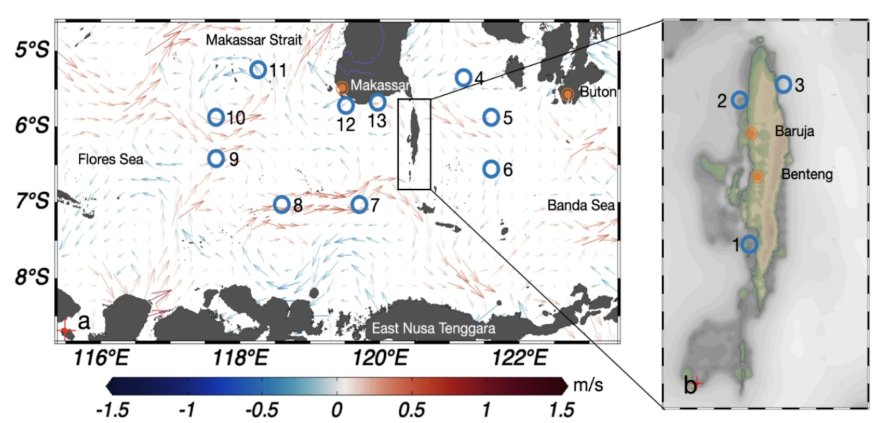


This study tracks how marine debris moves around the Selayar Islands by combining particle‑tracking models with on‑the‑ground surveys. The team released thousands of virtual “drifters” forced by observed winds and currents, then compared the simulated landfall patterns with standardized beach clean‑up and in‑situ observations. The approach helps separate what is locally generated from what is transported in by regional flows.
The results point to a clear seasonal signature. During the northwest monsoon (peaking in December), onshore winds and currents drive more debris toward Selayar’s shores than during the southeast monsoon. The modeling and field data converge on the same story: most stranded items originate from Selayar itself and its nearby river systems, with a secondary contribution from neighboring islands via the Indonesian Throughflow and mesoscale eddies. This dual evidence base—numerical and empirical—gives policymakers confidence to target interventions where they matter most.
Three practical actions emerge. First, prioritize river‑mouth interception (e.g., booms, waste traps) and community segregation upstream, since much of the load is land‑based. Second, time coastal clean‑ups and rapid‑response teams to monsoonal peaks when beaches receive the largest pulses. Third, deploy low‑cost monitoring (fixed cameras, citizen science) to verify model forecasts and refine local action plans. Together, these measures curb inputs (SDG 12) and reduce harm to ecosystems and tourism (SDG 14 and SDG 11).
Beyond Selayar, the framework is transferable to other Indonesian archipelagic settings where complex currents and seasonal winds control debris pathways. By tying science to practical, place‑based strategies, the work supports evidence‑led coastal management and measurable progress on marine litter reduction.
Read full article here: https://doi.org/10.1038/s41598-024-73373-0
Credits
Universitas Padjadjaran authors: Noir P. Purba; Ibnu Faizal; Marine K. Martasuganda; Titin Herawati; Ajeng Wulandari; Sanny T. Utami; Muhammad H. Ilmi; Raffy R. Alfarez; Buntora Pasaribu.
Other institutions involved: University of Manchester (David Christie); University of Edinburgh (Munawir B. Pratama); Earth Observatory of Singapore, Nanyang Technological University (Darryl A. Valino); National Research and Innovation Agency/BRIN (Noor C.D. Aryanto).
Hashtags: #UnpadResearch #SDG14 #MarineLitter #Selayar #OceanModeling