
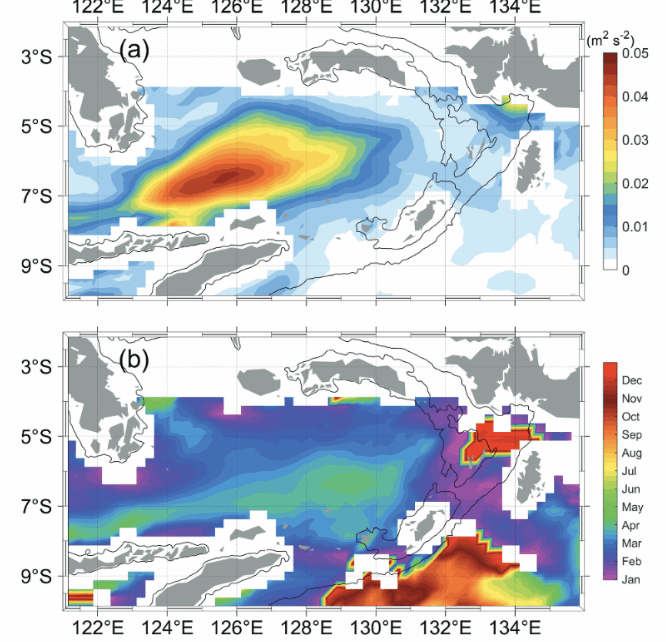


A new study published in All Earth (2025) reveals how ocean eddies—giant rotating currents—shape the Banda Sea’s circulation and energy balance. Using nearly three decades of satellite altimeter data (1993–2022), the research found that eddy kinetic energy (EKE) peaks between March and April, strongly influenced by the Southern Boundary Current (SBC). When the SBC intensifies, EKE levels rise, creating more active ocean mixing; when it weakens, EKE declines.
These findings provide valuable insight into the dynamics of the Indonesian Throughflow, a vital ocean current system connecting the Pacific and Indian Oceans. Understanding the variability of EKE is key to predicting climate impacts, supporting sustainable ocean resource management, and strengthening Indonesia’s role in global climate regulation.
This research contributes to the achievement of United Nations Sustainable Development Goals (SDG 13 – Climate Action, SDG 14 – Life Below Water, SDG 15 – Life on Land).
Full article: The interannual variability of the eddy kinetic energy in the Banda Sea inferred from satellite altimeter data
Meet the Researchers
This study was conducted by Ankiq Taofiqurohman (Universitas Padjadjaran), Mochamad Furqon Azis Ismail, Taslim Arifin, Handy Chandra (BRIN – National Research and Innovation Agency, Indonesia), and Kandaga Pujiana (University of Miami, USA).
Hashtags
#OceanScience #BandaSea #ClimateAction #OceanCurrents #SatelliteResearch #UnpadResearch #SDG13 #SDG14 #SDG15