
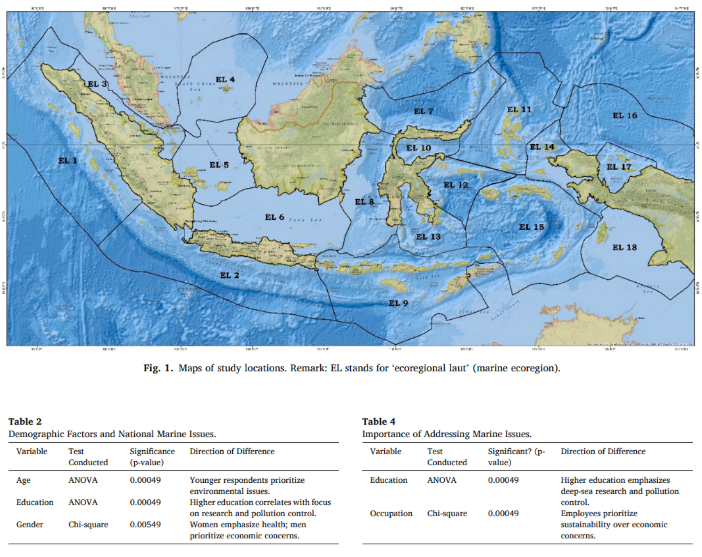


This study investigates how demographic factors—including age, gender, education, occupation, and length of residence—affect how Indonesians perceive and engage with marine conservation. The research gathered responses from 3,159 individuals across 18 marine ecoregions, using both surveys and interviews to capture national-level insights.
The findings reveal significant demographic differences in attitudes toward the ocean. Younger and more educated respondents were more concerned about pollution, climate change, and the need for marine research, while older individuals prioritized economic stability and resource management. Gender differences also emerged: women showed higher concern for environmental health and pollution impacts on households, whereas men focused more on economic benefits linked to fisheries and maritime industries.
Occupational roles influenced perceptions as well. Students and employees strongly supported conservation policies, while fishers and self-employed respondents emphasized immediate financial security. Additionally, long-term residents of coastal areas displayed stronger advocacy for marine sustainability compared to recent arrivals, reflecting the importance of place-based experience and cultural ties such as sasi laut (customary marine tenure) in shaping stewardship attitudes.
Statistical analysis confirmed these differences with moderate to high effect sizes. For example, women’s concern for pollution impacts was significantly higher (p < 0.01), and long-term residents showed notably stronger support for conservation initiatives (p < 0.01). These demographic insights point to the importance of inclusive, tailored marine governance.
Policy recommendations include:
- Gender-sensitive education to empower women in marine governance.
- Financial incentives for small-scale fishers to encourage sustainable practices.
- Integration of traditional governance systems (e.g., sasi laut) into formal marine management.
By embedding these demographic perspectives, the study argues that Indonesia’s Ocean Policy can become more adaptive, socially equitable, and effective in balancing conservation with socio-economic realities.
Credits
Meet the Researchers: This study was led by Agus Heri Purnomo and a multidisciplinary team from Indonesia’s National Research and Innovation Agency (BRIN), in collaboration with scholars from Universitas Padjadjaran, Universitas Riau, Universitas Brawijaya, Universitas Cenderawasih, Universitas Mataram, Universitas Sam Ratulangi, as well as international partners from The University of Tokyo, NOAA (USA), Ifremer (France), and CSIRO (Australia)
.
Hashtags
#OceanPerceptions #MarinePolicy #Indonesia #SDG14 #SustainableOceans #BlueEconomy #ClimateAction
Publication Link
https://www.sciencedirect.com/science/article/pii/S0308597X25001216?via%3Dihub