
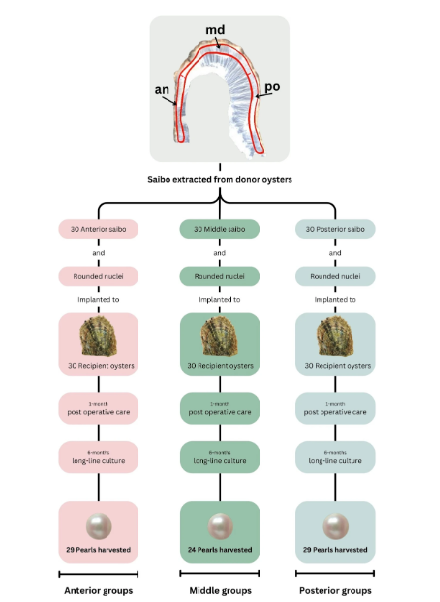


Cultured pearls are among the most valuable aquaculture products worldwide, with Japan playing a leading role in pearl oyster farming. However, pearl quality often varies due to biological and environmental factors. This study investigates a non-genetic method to enhance pearl quality by selecting posterior saibo (mantle tissue grafts) from donor oysters of Pinctada fucata martensii.
Pearl cultivation traditionally depends heavily on the genetic traits of donor oysters, but genetic breeding programs are costly and time-consuming. Instead, the researchers proposed a practical alternative: using mantle tissue from specific regions of the oyster that are believed to produce superior nacre (the substance forming the pearl).
The experiment compared pearls produced using posterior saibo grafts against those from anterior saibo grafts. Analysis of the harvested pearls included surface smoothness, luster, nacre thickness, and roundness, which are the key determinants of market value.
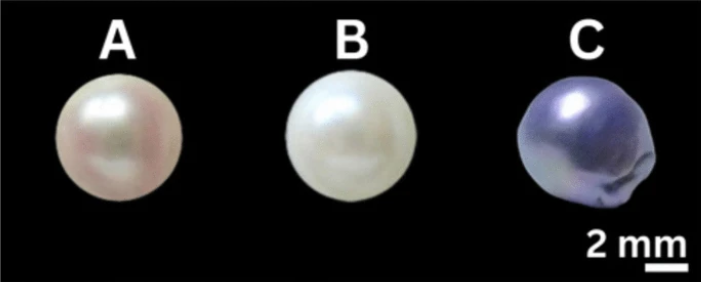
Results showed that posterior saibo grafts consistently produced pearls of higher quality, with superior luster and fewer surface defects. Although both groups produced pearls with similar nacre thickness, the posterior saibo group yielded pearls more aligned with premium market standards. This finding suggests that strategic tissue selection during grafting can improve pearl outcomes without requiring genetic modification or large-scale selective breeding programs.
From an industry perspective, this approach offers pearl farmers a cost-effective and sustainable method to enhance product value, reduce variability in pearl quality, and increase profitability. It also minimizes the need for genetic intervention, making it more accessible for small- and medium-scale farmers who lack advanced breeding facilities.
Overall, the study highlights how a better understanding of oyster biology can directly support aquaculture innovation, aligning with global sustainability goals by promoting responsible marine resource use and supporting the livelihoods of coastal communities dependent on pearl farming.
Credits
Meet the Researchers: This study was conducted by a team of pearl aquaculture specialists from Japanese marine science institutions, with expertise spanning molluscan biology, aquaculture technology, and sustainable pearl farming practices .
Hashtags
#PearlFarming #SustainableAquaculture #MarineBiotech #SDG14 #BlueEconomy #HighQualityPearls
Publication Link
https://link.springer.com/article/10.1007/s10499-025-01970-5