
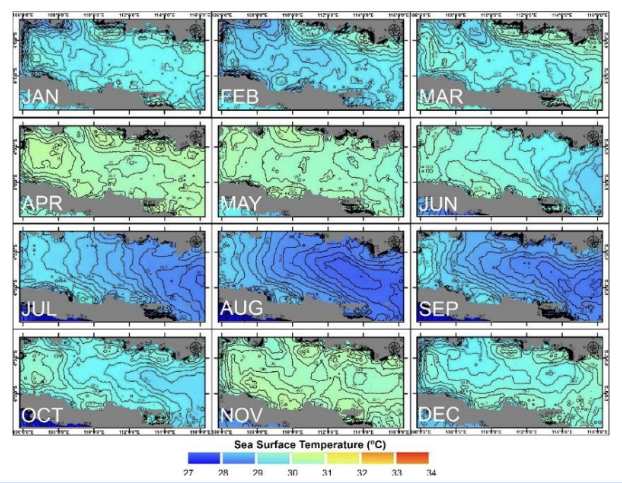


Researchers from Universitas Padjadjaran have published a new study, “Projected Impacts of Ocean Warming on the Potential Fishing Zone of Eastern Little Tuna (Euthynnus affinis) in the Java Sea” in the Egyptian Journal of Aquatic Biology & Fisheries (Vol. 29, 2025). Using satellite-derived sea surface temperature (SST), chlorophyll-a, and salinity data from 2016–2020, the team modeled how ocean warming scenarios of +1°C, +2°C, and +4°C would affect tuna habitats. The results reveal that under higher temperature scenarios, suitable fishing grounds shrink dramatically, shifting westward or disappearing altogether. This research directly supports SDG 13 (Climate Action) and SDG 14 (Life Below Water) by providing evidence-based insights for fisheries adaptation and sustainable management.
The findings underscore that eastern little tuna prefer SST ranges of 29–30°C for optimal catches. With ocean warming, potential fishing zones (PFZ) are projected to shift toward the coast or vanish, particularly under +2°C and +4°C scenarios. Such knowledge is vital for policy makers and local fishers to anticipate changing habitats, adjust fishing practices, and plan for climate-resilient fisheries management.
Meet the Researchers: This study was led by Mega Syamsuddin, Sheila Zallesa, Mochamad Ismail, and Fadli Syamsudin from the Faculty of Fisheries and Marine Science, Universitas Padjadjaran, in collaboration with the Center for Climate and Maritime Area Management and the National Research and Innovation Agency (BRIN). Their work highlights Unpad’s leadership in using remote sensing and GIS to develop predictive maps and support evidence-based decision making in marine resource management.
Reference: https://ejabf.journals.ekb.eg/article_405684.html
Hashtags: #SDG13 #SDG14 #ClimateAction #OceanWarming #FisheriesManagement #RemoteSensing #UnpadResearch