


Primary SDG: SDG 13 – Climate Action
Secondary SDGs: SDG 15 – Life on Land, SDG 11 – Sustainable Cities and Communities
Forests play a critical role in regulating Earth’s climate by storing carbon in their biomass. However, this natural function is increasingly threatened by land use and land cover (LULC) changes driven by agriculture, urbanization, and deforestation. To address this challenge, researchers developed a model to simulate how regional aboveground carbon stocks respond to shifts in land use over time. The study not only provides scientific insights but also informs strategies for sustainable land management and climate change mitigation.
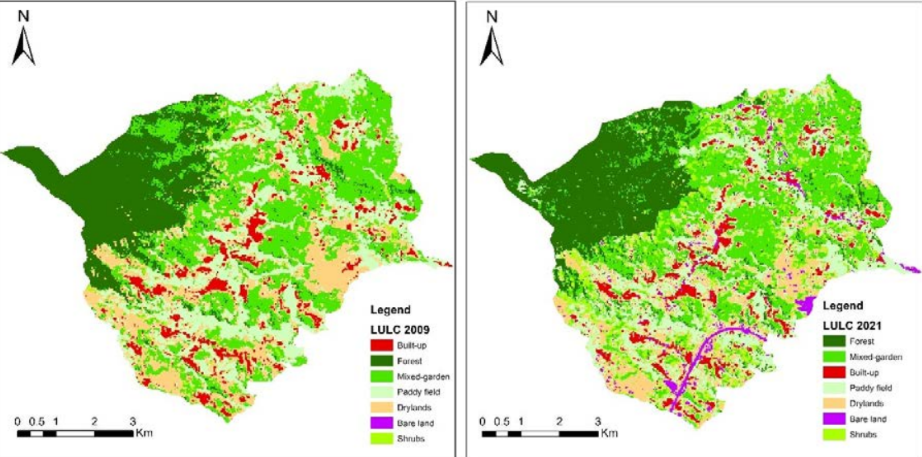
The research began by collecting and processing spatial datasets on land use and land cover changes over several decades. These data were then integrated with forest inventory records and carbon density values to estimate aboveground carbon storage. Advanced modeling approaches were employed to project how carbon stocks evolve under different scenarios of land use conversion—such as deforestation, plantation expansion, or natural regeneration.
The results showed that land use change is one of the most significant drivers of carbon loss. When forests are cleared for agriculture or settlement, the region’s carbon stocks decline sharply, contributing to higher greenhouse gas emissions. Conversely, areas undergoing reforestation, afforestation, or natural forest regrowth demonstrate substantial carbon gains, highlighting the critical importance of forest recovery programs.
Analysis of the model revealed spatial variability: some regions experienced severe losses where agricultural expansion was dominant, while others displayed resilience due to conservation initiatives. The findings underscore that policies aimed at sustainable land management—such as restricting deforestation, promoting agroforestry, and encouraging forest restoration—can greatly influence the trajectory of carbon stocks at the regional level.
This research demonstrates the effectiveness of combining geospatial analysis with carbon modeling to capture the dynamics of land–carbon interactions. It provides decision-makers with evidence to balance economic development and ecological sustainability. Importantly, the study illustrates that future carbon stock trajectories are not fixed but depend heavily on human choices about land management.
In conclusion, the study highlights the dual role of land use as both a risk and an opportunity in climate action. Protecting existing forests while promoting restoration and sustainable land practices is crucial to maintaining aboveground carbon stocks. The modeling framework developed here can serve as a decision-support tool for governments, conservation agencies, and urban planners seeking to integrate carbon considerations into regional development strategies.
Meet the Researchers: This study was led by researchers from Universitas Padjadjaran, in collaboration with partners specializing in land use, forestry, and climate science.
#UnpadResearch #SDG13 #ClimateAction #SDG15 #Forests #CarbonStocks #SustainableLandUse
Read the full paper here: https://www.scopus.com/pages/publications/85174336201