
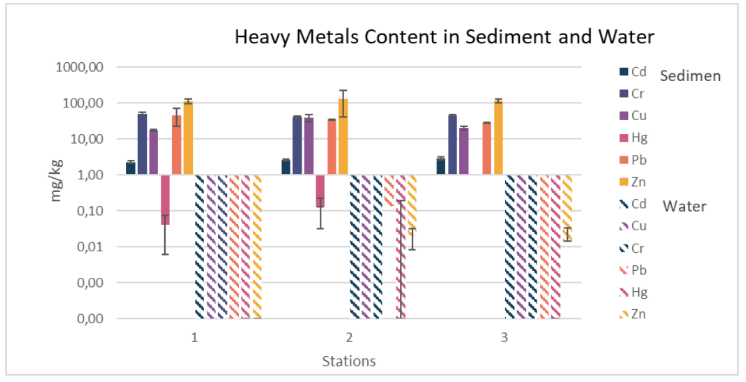


A research team from Universitas Padjadjaran has published a study on the distribution of heavy metals in seawater and sediments along the Cirebon coastal area, West Java. The study measured concentrations of cadmium (Cd), chromium (Cr), copper (Cu), mercury (Hg), lead (Pb), and zinc (Zn) at Nusantara Kejawanan Fishery Port and Gebang Mekar Fish Landing Base. Results showed that while some parameters remained within safe limits, cadmium (Cd) exceeded thresholds in all sediment samples, posing a serious ecological risk to aquatic life.
The study also revealed that Pb in seawater at Kejawanan Harbor had surpassed national standards, while Zn remained at safe levels. Using the STORET and ecological risk index methods, researchers found that water quality ranged from “Class A” (good) in mangrove areas to “Class C” (moderately polluted) at river estuaries. Sediment analysis confirmed Cd as the most concerning pollutant, with potential sources traced to industrial, domestic, and port-related activities.
This research highlights the urgent need for pollution monitoring and sustainable coastal management, in line with UN Sustainable Development Goals (SDGs) 6: Clean Water and Sanitation, 14: Life Below Water, and 15: Life on Land. The findings serve as an important reference for policymakers and local stakeholders to protect marine ecosystems and public health.
Full article: Distribution of Heavy Metals in Surface Seawater and Sediment of Cirebon Coastal Area, West Java
Meet the Researchers:
This study was conducted by Alisha D. Azzahra, Buntora Pasaribu, Eri Bachtiar, and Yudi N. Ihsan from the Faculty of Fisheries and Marine Science, Universitas Padjadjaran.
Hashtags:
#MarinePollution #HeavyMetals #SDG6 #SDG14 #SDG15 #UnpadResearch #CirebonCoast