



Original Title:
Alternation of qu (UCT) and Water Content (w) Parameters of East Borneo Expansive Clay under Wetting-Drying Process
SDGs Connection:
- Primary SDG: SDG 9 – Industry, Innovation and Infrastructure
- Secondary SDGs: SDG 11 – Sustainable Cities and Communities; SDG 13 – Climate Action
- Short Narrative Explanation:
Expansive clay soils pose a major challenge to infrastructure development due to their tendency to swell when wet and shrink when dry. This study focuses on expansive clay deposits in East Borneo, Indonesia, particularly along a 2,400 km stretch of national road that often suffers damage such as cracks, pavement failures, and pipeline disruptions caused by soil movement.
The research aimed to analyze how changes in water content (w) affect the unconfined compressive strength (qu) of these soils during repeated wetting–drying cycles. Laboratory experiments were conducted using samples classified as “fat clay” with high plasticity, dominated by montmorillonite minerals. Tests included varying water contents between 5–40% and applying Unconfined Compression Tests (UCT) under ASTM D 2166-06 standards.
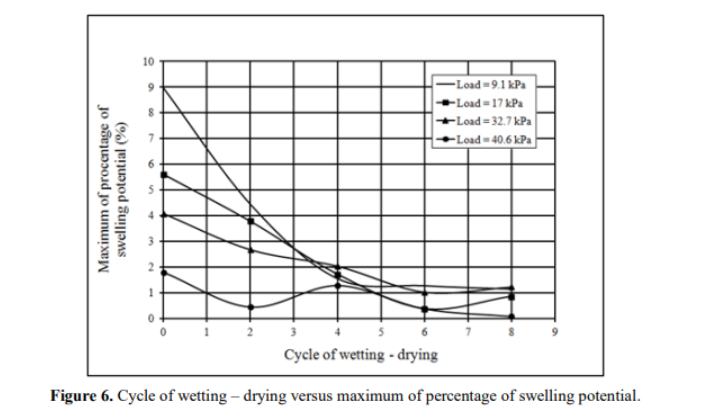
Results showed that water content strongly influences soil strength. Initial cycles of wetting–drying increased shear strength up to a peak at the fourth cycle, but subsequent cycles reduced strength and stability. After eight cycles, soil samples exhibited a significant drop in compressive strength (from 2.693 to 1.758 kg/cm²), along with reduced strain tolerance. The swelling potential also decreased with more cycles, stabilizing the soil but lowering its long-term load-bearing capacity.
These findings highlight the importance of managing expansive soils in construction projects. By understanding the relationship between soil moisture and strength, engineers can better design foundations, roadbeds, and drainage systems to minimize damage. The study suggests that natural drying or controlled oven drying at constant temperatures can help standardize testing conditions. Ultimately, this research provides critical baseline data for infrastructure planning and resilience in tropical regions prone to soil instability.
Credits:
This study was conducted by P.A.M. Agung (Politeknik Negeri Jakarta), M.A. Ahmad & A. Zainorabidin (Universiti Tun Hussein Onn Malaysia), M.F.R. Hasan (Politeknik Negeri Jakarta), M. Amir (Politeknik Negeri Ujung Pandang), and U.A. Abdurrahman (Nano Center Indonesia).
Hashtags:
#GeotechnicalEngineering #ExpansiveClay #InfrastructureResilience #SDG9 #SoilMechanics #SustainableCities
Publication Link:
https://iopscience.iop.org/article/10.1088/1755-1315/1453/1/012031