


Researchers from FPIK Universitas Padjadjaran, Dr. Noir Purba & Syawaludin Alisyahbana Harahap have revealed how long-term oceanographic data combined with new expedition findings can deepen the understanding of water mass stability and mixing in the Banda Sea. By analyzing salinity, temperature, and turbulent mixing, the study highlights the seasonal variability of ocean circulation in this critical region. These insights directly support SDG 13: Climate Action, by improving knowledge of how regional seas contribute to global climate systems, and SDG 14: Life Below Water, by providing essential information on marine ecosystem dynamics and the sustainability of ocean resources.
A recent oceanographic study has provided fresh insights into the stability and mixing of water masses in the Banda Sea, a critical region influencing large-scale ocean circulation. By combining more than five decades of global in situ ocean data (1960–2018) with new observations from the Jalacitra II Expedition in 2022, researchers have mapped the physical characteristics and seasonal variability of the Banda Sea’s water masses.
The study analyzed salinity and potential temperature to construct seasonal temperature-salinity-time diagrams and assess water column stability using the Brunt-Väisälä Frequency, while Thorpe analysis was employed to examine turbulent mixing. Results showed that during the Northwest Monsoon (NWM), surface temperatures reached around 30.0°C, while the Southeast Monsoon (SEM) registered cooler averages near 28.0°C. Salinity differences were also observed, with the SEM generally exhibiting lower values (33.5–34.4) compared to the NWM (34.0–34.5).
Vertical profiling revealed that the SEM season produced a more varied thermocline depth than the NWM. Data from the Jalacitra II expedition further confirmed these seasonal dynamics, showing a surface salinity of 33.3, and a uniform salinity of 34.6 persisting below 100 meters.
The analysis identified five dominant water masses in the Banda Sea, predominantly originating from the Pacific Ocean, including the North Pacific Intermediate Water (NPIW) and North Pacific Subtropical Water (NPSW). Seasonal instability was also evident, with water column instability extending to depths of 200 meters during the NWM and reaching 300 meters during the SEM, with stability values recorded at less than four cycles per hour. High turbulence was typically concentrated in the thermocline layer, between 50 and 300 meters.
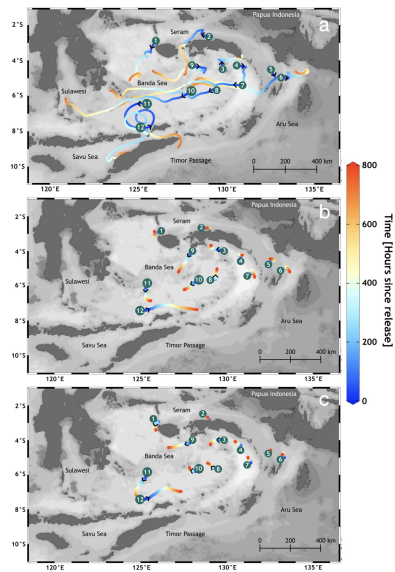
Particle pathways in the a) surface layer with start points from JC II stations, b) 600 m, and c) 1000 m
Researchers highlight that these findings are significant for understanding not only the Banda Sea’s role in regional oceanography but also its contribution to global circulation processes. The results underscore how seasonal variability, water mass distribution, and turbulent mixing in this area can influence broader climate and marine ecosystem dynamics. For further information and complete findings, please click on this journal link https://www.scopus.com/pages/publications/105009478178
Inventor: Dr. Noir Purba & Syawaludin Alisyahbana Harahap
#Sustainability #MarineScience #ClimateAction #LifeBelowWater #SDG13 #SDG14 #OceanCirculation #AquaticEcosystems #SustainableOceans