
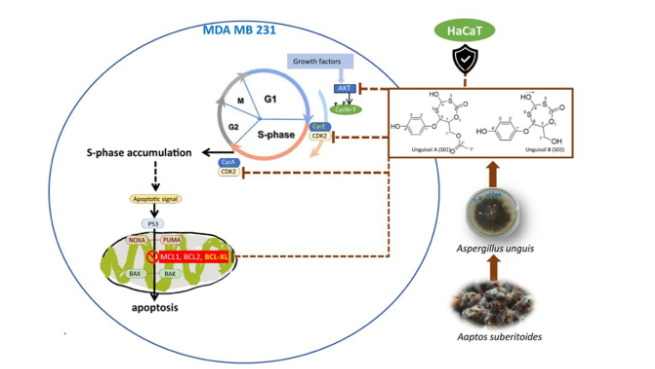


A research team led by Universitas Padjadjaran, in collaboration with Bandung Institute of Technology, IPB University, Universitas Andalas, and Universiti Malaysia Terengganu, has successfully identified two novel compounds—Unguisol A and Unguisol B—from the marine fungal symbiont Aspergillus unguis, isolated from sponges in the Seribu Islands, Indonesia. Published in the Journal of Experimental Pharmacology (2025), this breakthrough study demonstrates that both compounds are capable of inducing apoptosis and cell cycle arrest in triple-negative breast cancer (TNBC) cells, while showing no harmful effects on normal cells.
The findings highlight the immense potential of Indonesia’s marine biodiversity as a source of life-saving therapeutics. By downregulating critical genes (BCL2L1 and AKT1), Unguisol A and B effectively trigger programmed cancer cell death and inhibit uncontrolled cell proliferation. This research not only expands the frontier of marine-based drug discovery, but also supports global efforts in developing sustainable biomedical innovations that align with the United Nations Sustainable Development Goals (SDG 3 – Good Health and Well-being, SDG 14 – Life Below Water).
Meet the Researchers:
This study was conducted by Muhammad Hasan Bashari, Mochamad Untung Kurnia Agung, Eko Fuji Ariyanto, Laode Muhammad Ramadhan Al Muqarrabun, Syefira Salsabila, Agus Chahyadi, Andi Rifki Rosandy, Ervi Afifah, Merry Afni, Harold Eka Atmaja, Tenny Putri, Fitria Utami, Beginer Subhan, Syafrizayanti, Yosie Andriani, and Elfahmi from Universitas Padjadjaran, Bandung Institute of Technology, IPB University, Universitas Andalas, and Universiti Malaysia Terengganu
Hashtags:
#MarineBiotechnology #CancerResearch #DrugDiscovery #UniversitasPadjadjaran #SDG3 #SDG14