
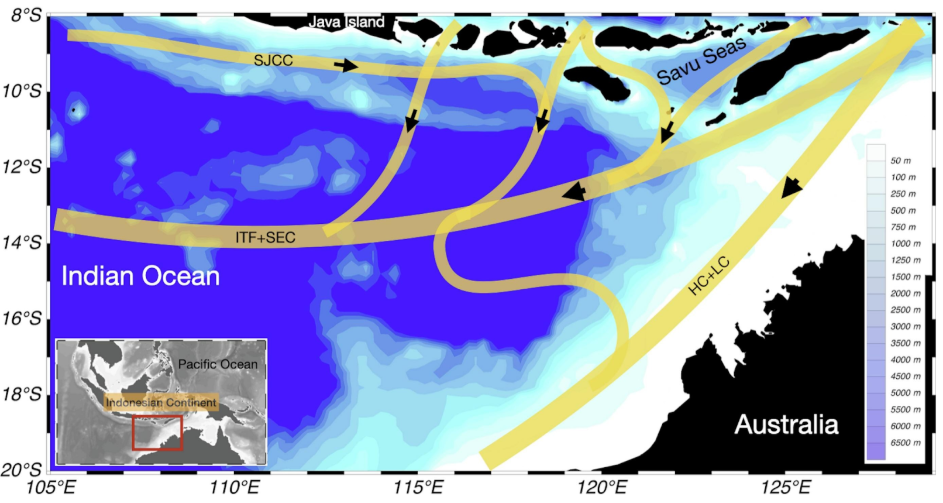


This study focuses on how La Niña events impact the ocean’s biophysical conditions in the Eastern Indian Ocean, a region stretching from southern Java to northwestern Australia. This area is particularly important because it is influenced by the Indonesian Throughflow (ITF) and strong upwelling systems, which supply nutrients to marine ecosystems and sustain rich biodiversity. Understanding how climate-driven events like La Niña affect these systems is essential for predicting shifts in marine productivity and managing fisheries sustainably.
The researchers analyzed sea surface temperature (SST), dissolved oxygen (DO), nitrate levels, chlorophyll-a (Chlor-a), and nanoplankton concentrations from 2019 to 2022. Data were obtained using satellite observations (e.g., AquaMODIS, Copernicus Marine Service) and validated against in-situ measurements. This period coincided with a rare “triple-dip” La Niña event, where the phenomenon persisted for three consecutive years.
The results revealed that La Niña strongly alters ocean conditions:
- SST: During La Niña, significant variations in surface temperature were observed, with warming up to 31°C in some areas but cooling in regions affected by upwelling. These anomalies influence nutrient mixing and oxygen distribution.
- Dissolved Oxygen: DO levels rose during certain seasons, reaching higher values in 2022 than in previous years. The ITF plays a crucial role in transporting oxygen-rich waters, but future declines in ITF strength could reduce oxygen availability.
- Nitrate: Levels fluctuated with seasonal monsoon cycles. Upwelling events brought nutrients from deeper layers, but denitrification during oxygen-poor conditions reduced available nitrate at the surface. Peaks were observed during transitions from El Niño to La Niña.
- Chlorophyll-a & Nanoplankton: Chlor-a, an indicator of phytoplankton biomass, varied with ENSO phases. Strong La Niña events led to decreases in Chlor-a, while weaker events or El Niño transitions boosted productivity. Nanoplankton trends closely mirrored Chlor-a patterns, highlighting their role in marine food webs.
The study emphasizes that climate variability directly impacts marine productivity by altering the availability of nutrients and oxygen, which in turn shapes phytoplankton growth and higher trophic levels, including fish stocks. These findings have important implications for fisheries management, food security, and climate adaptation strategies, as shifts in productivity influence livelihoods and ecosystems across the region.
By combining advanced satellite data with field validation, the research provides a comprehensive picture of how La Niña reshapes ocean health in the Eastern Indian Ocean. It highlights the urgent need for adaptive resource management in the face of increasing climate variability and contributes to global understanding of ENSO’s role in ocean systems.
Read the full paper here: https://www.sciencedirect.com/science/article/pii/S1385110124000662?via%3Dihub
This study was conducted by Alexander M.A. Khan, Muhammad H. Ilmi, Choerunnisa Febriani, Trisna D.A. Sidik, Fadilla N. Azizah, Defania S. Ramadhanti, and Noir P. Purba from Universitas Padjadjaran, Indonesia, with support from the European Space Agency and the Komitmen Research Group .
#UnpadResearch #LaNina #IndianOcean #MarineProductivity #SDG14 #ClimateAction #Fisheries #OceanScience