
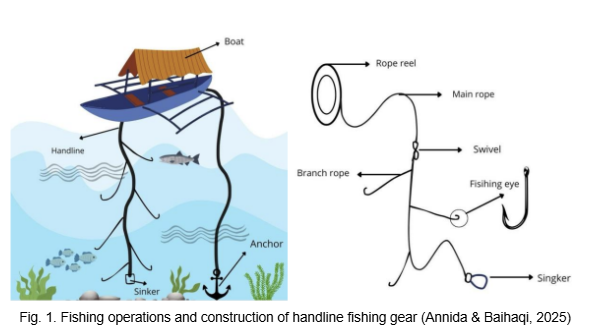
A new study published in the Egyptian Journal of Aquatic Biology & Fisheries (2025) highlights the dynamics of handline fishing fleets at the Palabuhanratu Nusantara Fishing Port, Sukabumi. Covering data from 2019–2023, the research reveals that ribbonfish (Trichiurus lepturus) dominate catches (>55%), yet overall productivity has declined by 4.26% per year. Seasonal analysis shows the peak fishing season occurs from September to November (especially October), while the lean season falls between December and February.
The findings stress the importance of accurate data collection and seasonal planning to support small-scale fishers—who make up more than 90% of Indonesia’s fishing communities. By understanding fishing cycles, policymakers and local communities can design better strategies to maintain productivity, reduce economic risks, and secure long-term sustainability. This aligns with the global agenda to ensure sustainable fisheries and resilient livelihoods.
This research contributes to the achievement of United Nations Sustainable Development Goals (SDG 2 – Zero Hunger, SDG 8 – Decent Work and Economic Growth, SDG 12 – Responsible Consumption and Production, and SDG 14 – Life Below Water).
Read the full article here: https://ejabf.journals.ekb.eg/article_422635.html
Meet the Researchers
This study was conducted by Faqih Baihaqi (Department of Fisheries, Universitas Padjadjaran) and Shafira Bilqis Annida (Marine Tourism Study Program, Universitas Padjadjaran).
Hashtags
#HandlineFisheries #Palabuhanratu #SmallScaleFisheries #SustainableFisheries #UnpadResearch #SDG2 #SDG8 #SDG12 #SDG14