
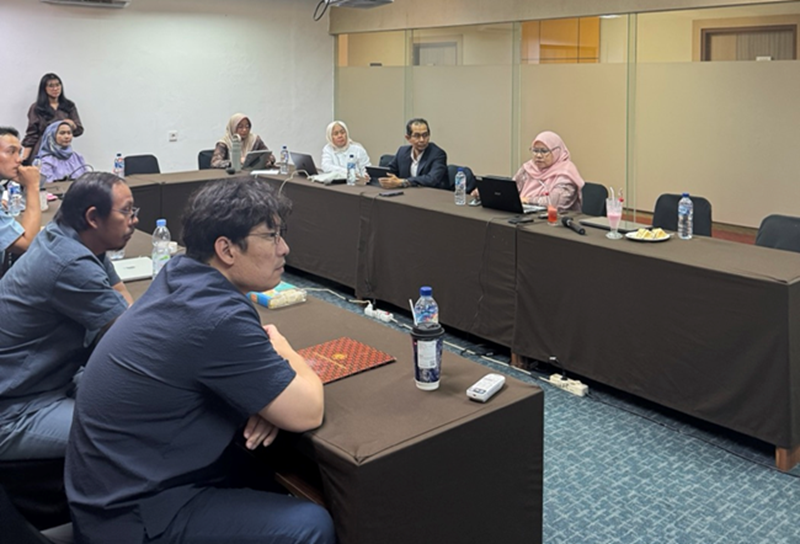
BANDUNG, Indonesia, 6 August 2026. Prof. Wang Zheng of the Institute of Oceanology, Chinese Academy of Sciences (IOCAS) visited the Faculty of Fisheries and Marine Science, Universitas Padjadjaran (FPIK Unpad) for a bilateral meeting reviewing a decade of joint marine science research and postgraduate education, and renewing a shared commitment to establish a joint marine science laboratory between the two institutions.
The session opened with remarks from Noir P. Purba, Head of the Doctoral Study Programme in Sustainable Fisheries and Oceans at FPIK Unpad, followed by a welcome address on behalf of the Dean, Dr. Sunarto, S.Pi., M.Si. Both speakers pointed to outcomes the partnership has already delivered, from joint training activities to postgraduate scholarships that have sent Unpad researchers to study in China, as evidence of a relationship built on sustained, practical cooperation rather than ceremony alone. As ocean science central to both climate resilience (SDG 13) and the conservation of marine resources (SDG 14), the partnership was framed as a direct contribution to Indonesia’s and China’s shared commitments under the UN 2030 Agenda.
IOCAS and the Indonesian Throughflow
IOCAS’s long-standing engagement in Indonesia has centered heavily on the Indonesian Throughflow (ITF), the ocean current system that carries Pacific water into the Indian Ocean through the Indonesian archipelago and plays a central role in regional and global climate regulation. As the Qingdao-based hub of the Chinese Academy of Sciences’ oceanographic research network, IOCAS has, over the past decade, supported joint mooring deployments, shipboard surveys, and shared observational infrastructure with Indonesian partners across key ITF passages, including the Makassar Strait and the Lombok and Ombai straits. This sustained presence has helped build one of the more consistent long-term monitoring records of the ITF’s variability in the region, contributing data that Indonesian researchers use to study heat and freshwater transport, monsoon dynamics, and climate-driven changes in the archipelago’s marine ecosystems. For Indonesia, this collaboration has meant access to observational capacity and technical expertise that would otherwise be difficult to sustain independently, while for IOCAS it has meant a stable scientific foothold in a region whose oceanography is central to understanding Indo-Pacific and global climate variability.
Unpad’s Commitment to International Research Collaboration
Universitas Padjadjaran’s participation in the partnership reflects the university’s broader institutional commitment to international research collaboration. As a higher education institution, Unpad has consistently supported cross-border joint degree pathways, co-supervised doctoral research, and shared access to observational infrastructure with its international partners, treating sustained collaboration abroad as central to its research mission rather than a peripheral activity. This orientation is visible in the steady flow of Unpad-affiliated researchers who have pursued postgraduate degrees at UCAS under Chinese Government, UCAS, and ANSO scholarship pathways, as well as in the university’s continued investment in joint publications, joint field campaigns, and shared laboratory access with IOCAS. FPIK Unpad’s leadership has framed this outward-facing posture as essential to producing marine science that meets international standards while remaining grounded in Indonesia’s own coastal and oceanographic priorities.
Mega L. Syamsuddin, Ph.D., then presented an overview of FPIK’s Center for Climate Studies and Maritime Area Management, explaining how shifting climate patterns are affecting tuna distribution and catch in Indonesian waters, underscoring the relevance of joint climate-ocean research to the country’s fisheries sector.
Looking Ahead
The event closed with a discussion between Prof. Wang Zheng and FPIK. Dr rer.nat Santi R. Anggraini (head of Research and Academic) highlighted on the practical shape of the bilateral relationship going forward, including the cadence of joint workshops, conferences, and annual meetings that have anchored the partnership year to year. Both sides agreed that future meetings will be conducted more intensively going forward, with particular focus on advancing construction of the joint marine science laboratory and on deploying shared air-sea flux instrumentation, which measures the exchange of heat, moisture, and momentum between the ocean and atmosphere and is considered essential to improving regional climate and monsoon forecasting. Delegates indicated that scoping for the instrumentation and the physical laboratory space would proceed in the coming months, positioning the next phase of the partnership around building durable, shared observational infrastructure rather than one-off exchanges.