
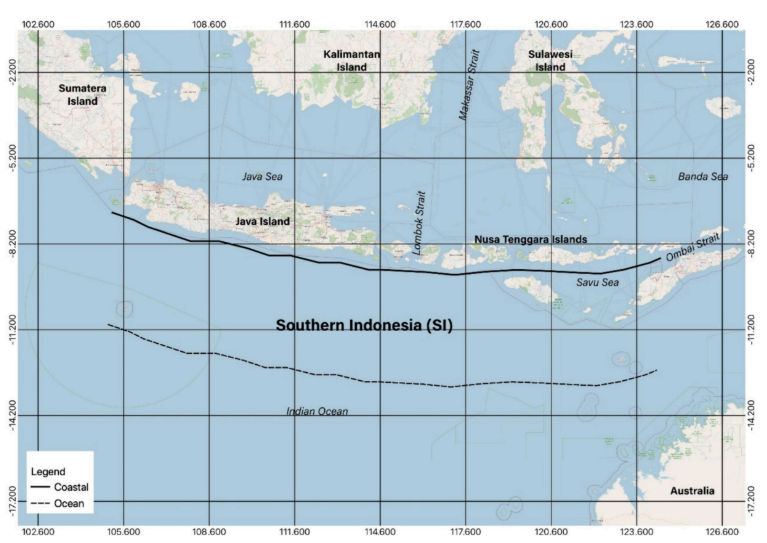


Researchers propose and test a satellite‑based upwelling index for the Southeastern Indian Ocean, then explore how this index connects to large‑scale climate drivers—the Indian Ocean Dipole (IOD) and El Niño–Southern Oscillation (ENSO). Using multi‑year records of sea surface temperature (SST), chlorophyll‑a, and wind, the team constructs an index that better captures coastal upwelling intensity and timing along southern Java and adjacent waters.
Analyses show that the IOD exerts the strongest influence on the new index during June–October, when southeasterly winds and wind‑stress curl intensify upwelling. ENSO plays a secondary but still significant role, modulating anomalies in SST and chlorophyll‑a that either reinforce or offset IOD signals. By linking the index to fishery‑relevant biophysical changes, the study provides a practical tool to anticipate productive periods for small pelagics and to interpret interannual swings in catch.
The work matters for policy and livelihoods. Early recognition of strong positive IOD phases allows managers and fishers to prepare for increases in productivity without triggering unsustainable effort. Conversely, during years when upwelling weakens, planning can focus on diversifying income and protecting spawning grounds. The index also improves communication: it distills complex ocean–atmosphere interactions into a metric that can feed seasonal advisories and aquaculture planning.
More broadly, this approach aligns with climate‑ready fisheries management—tracking drivers, anticipating change, and responding adaptively. It advances SDG 13 by turning climate science into actionable information, while supporting SDG 14 through smarter, ecosystem‑based fisheries and SDG 2 by safeguarding food security in coastal communities.
Read full paper here: https://doi.org/10.1016/j.seares.2024.102543
Credits
Universitas Padjadjaran authors: Martiwi Diah Setiawati.
Other institutions involved: Collaborators include Herlambang Aulia Rachman; Zainul Hidayah; Achmad Fachruddin Syah; Muhammad Rizki Nandika; Jonson Lumban‑Gaol; Abd. Rahman As‑syakur; and Fadli Syamsudin (from partner institutions such as IPB University, Udayana University, and Indonesian research agencies)..
Hashtags: #UnpadResearch #SDG13 #Upwelling #IndianOcean #Fisheries