
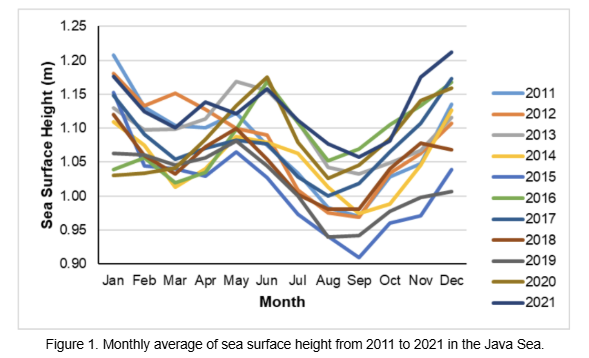


A new study published in AACL Bioflux (2025) investigates the variability of sea surface temperature (SST) and sea surface height (SSH) in the Java Sea and their connection to global warming. Using 11 years of satellite data (2011–2021), the research revealed a rise in the monthly mean SST by 0.31°C (from 28.82°C to 29.13°C) and SSH by 0.05 m (from 1.08 m to 1.13 m). These changes not only reflect global temperature trends but are also influenced by El Niño–Southern Oscillation (ENSO) events and seasonal monsoon systems.
The findings highlight that the Java Sea, located between the Pacific and Indian Oceans, is highly sensitive to climate variability. Rising SST and SSH threaten marine ecosystems, fisheries, and coastal communities through impacts such as coral bleaching, habitat degradation, and changes in rainfall patterns. This research provides essential insights for disaster mitigation and adaptation strategies in the face of climate change, contributing directly to the United Nations Sustainable Development Goals (SDG 13 – Climate Action, SDG 14 – Life Below Water, SDG 15 – Life on Land).
Full article: Variability in sea surface temperature and sea surface height in connection with global warming in the Java Sea
Meet the Researchers:
This study was conducted by Mega L. Syamsuddin, Hafidz D. Haq, Mochamad Rudyansyah Ismail, Fadli Syamsudin, Sunarto, and Umar Abdurrahman from the Department of Marine Sciences and the Center for Climate and Maritime Area Management, Faculty of Fisheries and Marine Sciences, Universitas Padjadjaran.
Hashtags:
#ClimateChange #JavaSea #MarineResearch #OceanWarming #UnpadResearch #SDG13 #SDG14 #SDG15